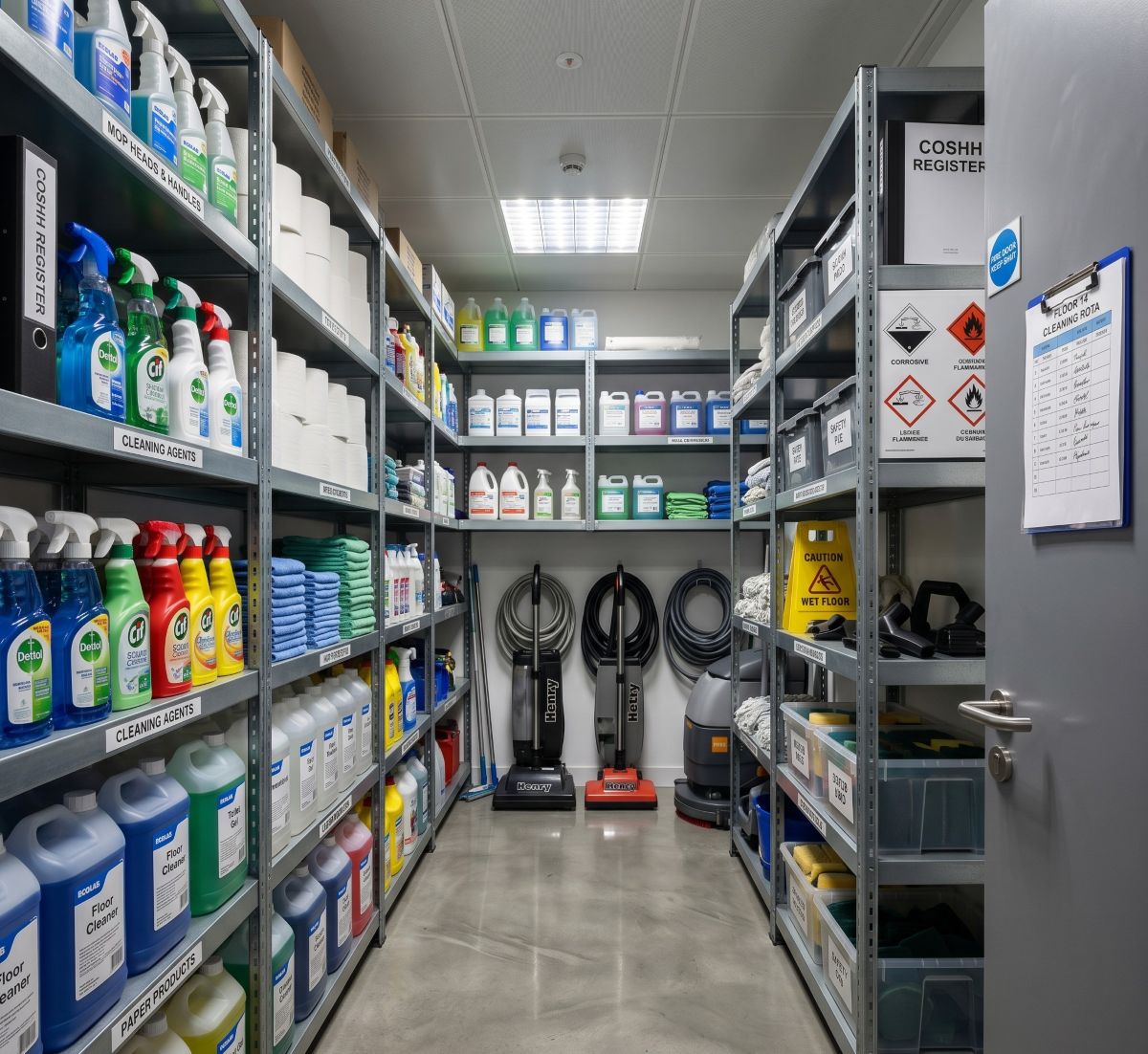
Somewhere in the sustainability team of a mid-sized London professional services firm, an ESG report is being assembled. A consultant is populating a GRI-aligned spreadsheet with data from across the business: energy consumption from facilities, waste diversion rates from the building manager, supply chain information from procurement. At some point, a question arises about the cleaning contractor. Does the contractor pay the London Living Wage? What are the sustainability credentials of the products used on-site? Can the contractor provide carbon data for its operations in the building?
For most London businesses building out their ESG reporting in 2026, the cleaning contract is a line item that has gone largely unexamined from a sustainability perspective. It does not have to remain one – and for cleaning contractors willing to engage seriously with the ESG agenda, that represents a significant commercial opportunity.
ESG Reporting Has Changed the Procurement Conversation
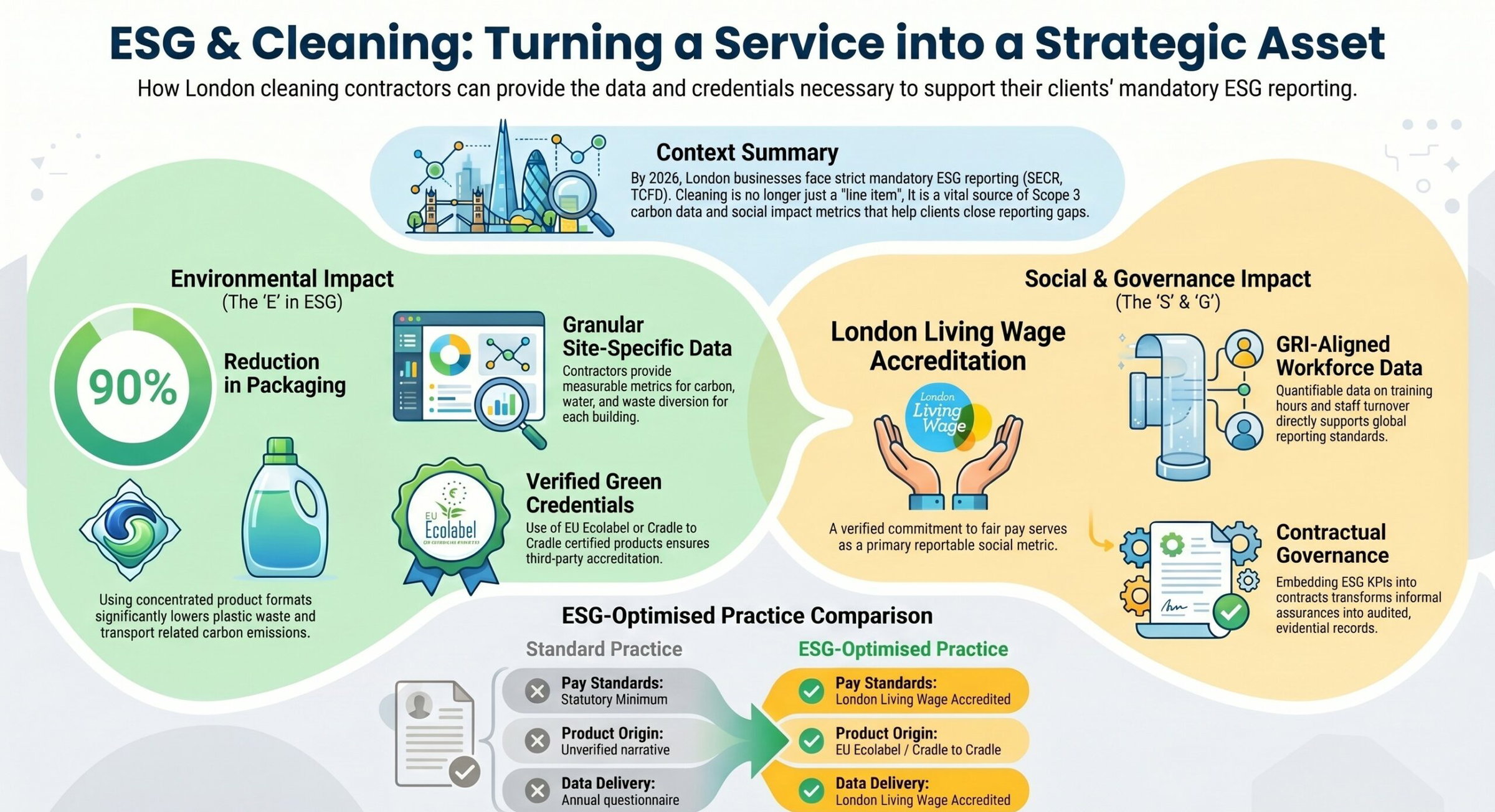
For much of the past decade, ESG commitments in corporate reporting were largely voluntary, largely narrative, and largely unchecked. That landscape has changed substantially. Large UK companies are now subject to mandatory Streamlined Energy and Carbon Reporting requirements under SECR, and the Task Force on Climate-related Financial Disclosures framework is embedded in the reporting obligations of publicly listed and financially significant UK businesses. Institutional investors, major corporate clients, and public sector procurement processes increasingly apply ESG criteria to supplier selection and evaluation.
For London businesses operating under these pressures, supply chain transparency – including the practices of cleaning contractors – is moving from an optional disclosure to an expected one. Scope 3 emissions, which cover indirect emissions within a company’s value chain, explicitly include outsourced services. A client whose cleaning contractor cannot account for its carbon footprint has a gap in its Scope 3 reporting – and that gap is becoming harder to justify.
The Environmental Contribution Cleaning Contractors Can Make
The environmental dimension of cleaning is often reduced, in clients’ minds, to a vague notion of green products. A cleaning contractor with genuinely strong environmental credentials can contribute meaningfully and measurably to several of the most reported environmental metrics.
Product Selection and Certification
Product choice is the most visible environmental lever a cleaning contractor controls, and the one most amenable to independent verification. Products certified under the EU Ecolabel scheme, the Nordic Swan standard, or Cradle to Cradle certification carry third-party accreditation that clients can reference directly in their sustainability reporting. These certifications cover not only the environmental impact of the product in use – reduced aquatic toxicity, biodegradable formulations, lower volatile organic compound emissions – but in many cases the manufacturing and supply chain credentials behind the product.
Concentrated product formats represent a less visible but equally significant contribution. A single concentrated litre that dilutes to ten litres of ready-to-use solution reduces packaging by up to 90 per cent and lowers transport emissions per unit of cleaning output by a comparable margin. Switching from single-use disposable cloths to microfibre systems reduces consumable waste further. These figures are quantifiable, attributable, and reportable – precisely the qualities that ESG frameworks demand.
Carbon, Water, and Waste Data
Beyond product credentials, the environmental metrics that matter most in an ESG context are those that can be measured, attributed to a specific site, and reported against a baseline. A cleaning contractor operating across a client’s London estate can, in principle, provide estimated carbon emissions associated with service delivery at each site, alongside water consumption figures and waste generation and diversion data showing the proportion of operational waste diverted from landfill through recycling or composting.
Few London cleaning contractors currently provide this level of granular, site-specific data as standard. The systems required to generate it are principally a matter of measurement discipline and reporting infrastructure rather than technical complexity. Contractors who invest in building that infrastructure are offering clients something genuinely useful, and distinguishing themselves from the large majority of the market that cannot.
The Social Dimension – Often the Strongest Contribution
If the environmental contribution of a cleaning contractor is a matter of product credentials and operational data, the social contribution is often more fundamental – and more directly connected to the day-to-day experience of the people delivering the service.
Fair Pay, Staff Welfare, and the London Living Wage
The London Living Wage – set independently by the Living Wage Foundation at a rate consistently higher than the statutory National Living Wage – is one of the most commonly reported social metrics in GRI-aligned ESG frameworks and an explicit criterion in a growing number of London public sector and corporate procurement processes. Accreditation as a Living Wage employer, which requires a verified commitment to paying the London rate to all directly employed and regularly contracted staff, is a reportable credential clients can include directly in their supply chain social disclosure.
Staff turnover rate is a further social metric that cleaning contractors are well-placed to contribute. High turnover is widely used as a proxy indicator for employment quality; a contractor with demonstrably low turnover – achievable through fair pay, reliable scheduling, and genuine investment in workforce wellbeing – provides clients with positive evidence rather than simply the absence of negative indicators. Combined with documented compliance with the Modern Slavery Act 2015 and a published supply chain transparency statement, this constitutes a substantive and reportable social record.
Workforce Development and the Supply Chain Narrative
GRI Standards – the most widely adopted global framework for sustainability reporting – include specific indicators for employee training and development, diversity and equal opportunity, and labour practices in the supply chain. A cleaning contractor that can provide structured data against these indicators, even in summary form, makes the client’s reporting task considerably easier and strengthens the credibility of the disclosure.
Training hours per employee per year, workforce diversity data, and evidence of active development pathways – apprenticeship schemes, professional qualifications through the British Institute of Cleaning Science, management progression routes – are all metrics that translate directly into GRI-reportable social data. The narrative dimension matters alongside the quantitative: ESG reports increasingly include qualitative evidence of social impact, and a London cleaning contractor with genuine workforce development commitments gives clients material they can use to bring their supply chain social credentials to life in a way that raw numbers alone cannot.
Governance, Accreditation, and the Data Infrastructure
The governance dimension of ESG support is, in many respects, the foundation on which environmental and social contributions rest. Without documented policies, third-party verification, and reliable data provision, a contractor’s sustainability credentials remain assertions rather than evidence.
Certifications That Appear in ESG Reports
Several accreditations commonly held by cleaning contractors translate directly into reportable ESG credentials for clients. ISO 14001 certification – the international standard for environmental management systems – confirms that a contractor’s environmental practices are systematically managed and independently audited. ISO 45001, covering occupational health and safety management, speaks to the social pillar. Living Wage Foundation accreditation is a recognised and verifiable social commitment. CHAS and SafeContractor accreditation provide a governance baseline relevant to supply chain due diligence.
B Corp certification, while still relatively uncommon in the cleaning sector, is the most comprehensive of these frameworks, assessing environmental, social, and governance performance across a business holistically. For cleaning contractors with genuine commitments across all three pillars, B Corp certification represents a significant differentiator in a London market where ESG credentials are moving from a soft consideration to a hard procurement criterion.
Providing Data Clients Can Actually Use
Accreditation alone is insufficient. The practical ESG support London clients need from a cleaning contractor is not a certificate on a wall but a structured, regular flow of data that can be incorporated into their own reporting cycles. This means carbon and water figures attributable to specific buildings, product sustainability credentials in a format procurement teams can record and evidence, waste diversion data by site, and social metrics – pay rates, staff turnover, training hours – provided on a consistent schedule aligned to the client’s reporting calendar.
Contractors who invest in the systems required to generate and share this data are not simply being helpful. They are building a competitive position in a procurement environment that increasingly rewards transparency and penalises the absence of it.
Building ESG Into the Cleaning Contract
The most reliable way to ensure ESG support is consistently delivered is to embed the relevant obligations, metrics, and reporting structures in the cleaning contract itself rather than treating them as relationship add-ons dependent on the goodwill of the current account manager.
A contract designed to support ESG reporting should specify the sustainability credentials of the products to be used, the pay standards that apply to the workforce, and the reporting deliverables expected from the contractor: what data will be provided, in what format, and at what frequency. KPIs aligned to ESG metrics – product certification compliance, Living Wage accreditation maintenance, staff training hours per quarter – make sustainability commitments measurable and create a shared accountability framework that benefits both parties. For London businesses whose ESG reporting is subject to audit or investor scrutiny, contractual commitments from cleaning contractors carry significantly more evidential weight than informal assurances or annual questionnaire responses. The contract is the record; everything else is conversation.
Every Line in the Supply Chain Counts
ESG reporting has made one thing clear that London procurement departments are absorbing at different speeds: a business cannot credibly claim strong sustainability performance while remaining incurious about the practices of the contractors who deliver services inside its buildings every day. Cleaning is not peripheral to that picture. It is present in every office, on every floor, on every working day – and the contractor delivering it makes dozens of decisions, from product selection to pay rates to waste management, that feed directly into the environmental, social, and governance metrics that clients are now publicly accountable for.
For cleaning contractors, this shift in expectations is not a burden. It is a structural market change that rewards investment in genuine sustainability credentials with stronger client relationships, longer contracts, and access to procurement processes that less-prepared competitors cannot enter. The cleaning industry has always operated closer to the margins of commercial life than its importance warrants. ESG reporting is one of the mechanisms through which that is beginning to change.