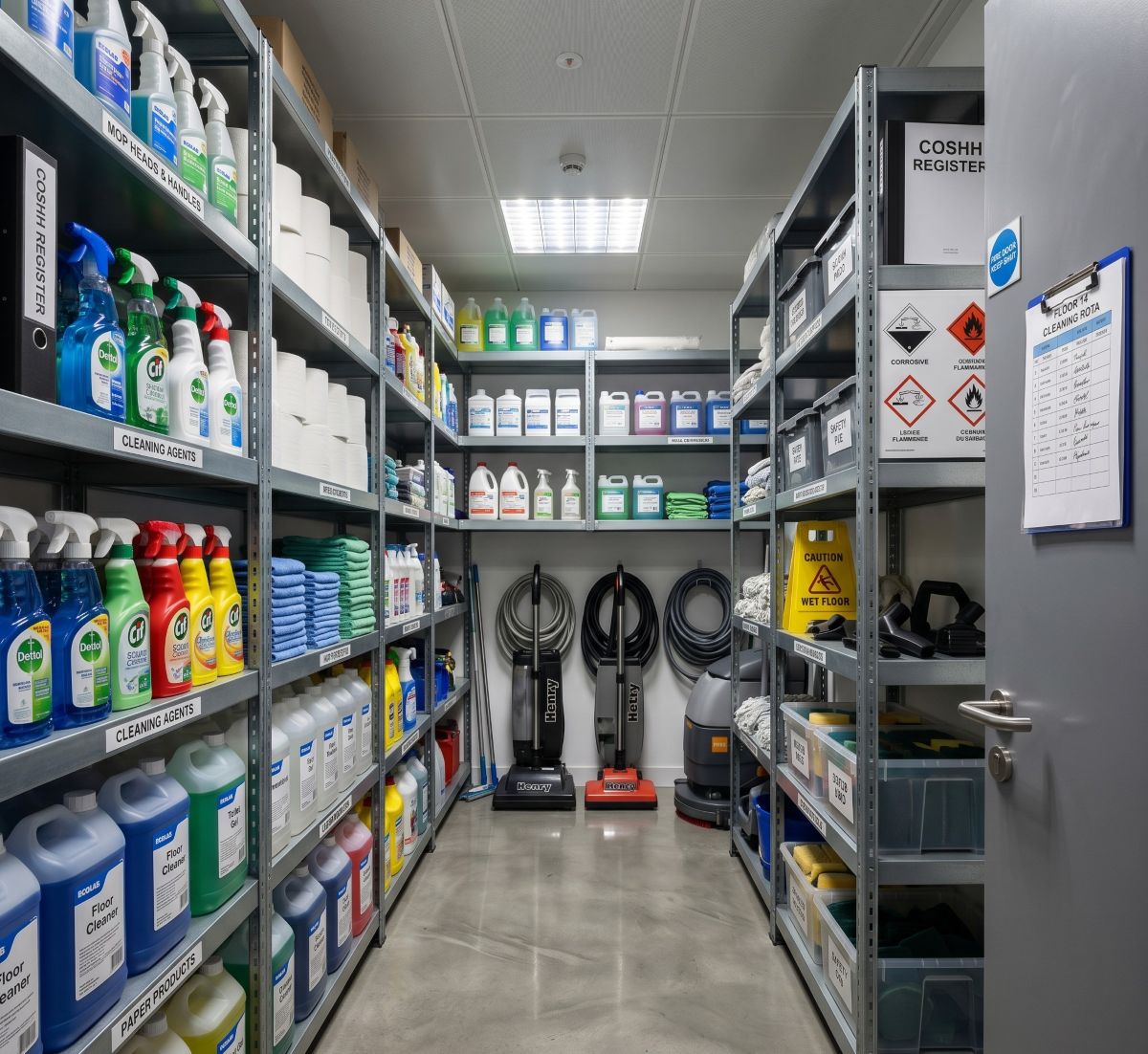
Open the cleaning cupboard of almost any commercial building in London and you will find the same mix: bottles of varying sizes, aerosol cans, concentrate containers, trigger sprays, and the occasional unlabelled decant from a bulk order. Most of these products are entirely routine in a professional cleaning context. Some of them are flammable. A small number, stored incorrectly or in proximity to incompatible substances, carry a fire risk that building owners, facilities managers, and cleaning contractors routinely underestimate. The fire safety risks associated with cleaning chemical storage are not theoretical – they are documented in incident reports, flagged in fire risk assessments, and covered by a regulatory framework that places clear legal obligations on anyone responsible for commercial premises. In London’s dense, varied, and frequently older building stock, those obligations deserve serious attention.
Why Cleaning Chemicals Present a Genuine Fire Risk
The range of products used in commercial cleaning is wider than most people outside the industry appreciate. Alcohol-based sanitisers and surface disinfectants – deployed extensively since the pandemic and now standard in most London offices – contain isopropyl or ethyl alcohol at concentrations that are formally classified as flammable liquids. Solvent-based floor treatments, furniture polishes, and some specialist surface cleaners contain hydrocarbons or acetone-based compounds with low flash points. Aerosol products – glass cleaners, degreasers, air fresheners – are pressurised containers that become significantly more hazardous when stored in warm or poorly ventilated spaces.
The risk is compounded by volume and proximity. A cleaning contractor servicing a multi-floor commercial building in the City or Canary Wharf may store several weeks’ worth of supplies in a single basement or riser cupboard. Oxidising agents – bleach-based products, peroxide cleaners – stored alongside flammable solvents create conditions in which a relatively minor ignition source can produce a disproportionately serious fire. In older London buildings with limited ventilation and shared service infrastructure, the consequences of a chemical store fire are not easily contained.
The Regulatory Framework Cleaning Contractors Must Understand
Flammable chemical storage in commercial premises is governed by overlapping legislation that assigns responsibility to multiple parties. Cleaning contractors operating across Greater London are not passive occupants of storage spaces – they are, in many contexts, legally accountable for what those spaces contain.
The Regulatory Reform (Fire Safety) Order 2005
The Regulatory Reform (Fire Safety) Order 2005 – the primary fire safety legislation for non-domestic premises in England – places responsibility for fire safety on the “responsible person”: typically the employer, the building owner, or whoever has control of the premises. Where a cleaning contractor controls a storage area within a building, they may themselves be a responsible person in relation to that space.
Under the Order, the responsible person is required to carry out a fire risk assessment, identify fire hazards, and take reasonable steps to reduce risk. Flammable chemical stores are a textbook fire hazard, and a fire risk assessment that fails to consider the contents of a cleaning contractor’s storage area – including the quantities stored, the ventilation arrangements, and the proximity to ignition sources – is, at best, incomplete and, at worst, a liability in the event of an incident.
COSHH and DSEAR: The Chemicals-Specific Framework
Two further pieces of legislation apply directly to the management of hazardous substances in the workplace. The Control of Substances Hazardous to Health Regulations 2002 – COSHH – requires employers to assess the risks associated with any hazardous substance used at work and implement appropriate controls. For cleaning contractors, this means that every flammable product in use should be covered by a COSHH assessment that considers storage conditions, exposure risks, and emergency procedures.
The Dangerous Substances and Explosive Atmospheres Regulations 2002 – known as DSEAR – go further, applying specifically to flammable liquids and gases. DSEAR requires that workplaces where dangerous substances are present are assessed for explosion and fire risk, that appropriate storage and handling controls are in place, and that employees receive relevant information and training. Critically, DSEAR applies to the employer of the people using the substances – which, in a contracted cleaning arrangement, means the cleaning contractor bears direct responsibility for compliance in relation to their own staff, regardless of who owns or manages the building. For any cleaning operation using alcohol-based products, solvent cleaners, or pressurised aerosols in significant quantities, DSEAR compliance is not optional.
Common Storage Mistakes and Why They Matter
The most serious chemical storage failures in commercial cleaning environments are rarely the result of deliberate risk-taking. They are overwhelmingly the result of convenience, time pressure, and the absence of clear guidance.
Storing Incompatible Chemicals Together
The most hazardous single mistake in cleaning chemical storage is placing oxidising agents and flammable substances in the same space without segregation. Oxidising agents – products containing bleach, hydrogen peroxide, or peracetic acid – accelerate combustion in the presence of fuel. A flammable solvent stored next to a bleach-based cleaner is not simply two bottles on a shelf: it is a combination that, in the event of a spillage or container failure, can ignite with significantly less external energy than either substance would require in isolation.
Product segregation is not a bureaucratic nicety – it is a fundamental principle of chemical storage safety, and it should be reflected in the physical layout of every cleaning store, however small.
Ventilation, Temperature, and Container Integrity
Flammable liquids release vapour continuously, and vapour concentration in an enclosed, unventilated space can reach ignitable levels even without any obvious spillage or leak. Cleaning cupboards in older London buildings – basement rooms, under-stair voids, shared riser cupboards – frequently have minimal natural ventilation and are subject to temperature fluctuations that accelerate vapour release from products with low flash points.
Aerosol cans present a specific temperature risk: they should never be stored in areas where temperatures can exceed 50 degrees Celsius, and should be kept away from boiler rooms, hot water pipes, and direct sunlight. Container integrity is equally important – damaged, corroded, or leaking containers should be removed from storage immediately and disposed of via appropriate waste channels, not left in situ because disposal is inconvenient.
Best Practice for Flammable Chemical Storage
Designated, Compliant Storage Facilities
The standard for flammable chemical storage in a commercial cleaning context is a purpose-designed, ventilated metal storage cabinet – commonly referred to as a COSHH cabinet. These provide passive ventilation to prevent vapour build-up, contain spillages, and resist the spread of fire in the event of ignition. They are widely available, relatively inexpensive compared to the risk they mitigate, and referenced in HSE guidance as the appropriate storage solution for flammable liquids in workplace environments.
Where a dedicated COSHH cabinet is not practicable – in buildings where storage space is severely constrained – the minimum requirements are clear segregation between incompatible product types, a ventilated space, and storage away from any ignition sources, including electrical equipment, boiler infrastructure, and lighting fixtures that generate significant heat.
Quantities, Labelling, and Original Containers
Quantities stored on-site should be limited to what is reasonably required for the current service period. Bulk storage of flammable products beyond operational need increases risk without operational benefit, and HSE guidance sets a working limit of 50 litres of flammable liquids in an unprotected workplace area – a threshold that a poorly managed cleaning store can exceed without anyone noticing. All products should remain in their original, manufacturer-labelled containers – decanting into unlabelled or generic containers removes the hazard information, GHS warning symbols, and emergency guidance that operatives and emergency services rely on. Safety data sheets for every product in use should be accessible in the storage area, not filed remotely or held only in digital form.
Staff Training and Fire Safety Protocols
What Cleaning Operatives Need to Understand
Cleaning staff are the people most directly exposed to chemical storage risks, and they are often the least well-informed about them. Effective training for operatives working with flammable products should cover the meaning of GHS hazard symbols – in particular the flame symbol indicating flammability and the flame-over-circle indicating an oxidiser – so that staff can identify hazardous products by label alone. It should address the fundamental rule against mixing products, the importance of returning products to correct storage after use, and the specific prohibition on storing aerosols or flammable liquids near heat sources. Given the multilingual nature of London’s cleaning workforce, training materials and safety signage should be available in the relevant languages rather than assumed to be understood from English-only documentation.
Incident Reporting and Emergency Preparedness
Every cleaning contractor operating in Greater London should have a documented procedure for chemical storage incidents – spillages, container failures, and suspected incompatible mixing – that does not rely on individual operatives making judgement calls in the moment. The procedure should be simple, known to all staff, and communicated to the client building’s fire warden or facilities manager so that the location and contents of chemical stores are factored into the building’s own emergency planning. Where a cleaning contractor manages multiple sites across London, a consistent incident reporting procedure across all sites – rather than ad hoc arrangements at each building – is both more effective and more defensible from a compliance perspective. A fire service attending an incident in a commercial building will need to know if flammable chemicals are stored on the premises: that information should not have to be discovered on arrival.
The Store Room Is a Fire Risk Too
Flammable chemical storage is one of the most manageable fire risks in a commercial building – which makes it one of the most avoidable sources of serious incidents. The hazards are well understood, the regulatory framework is clear, the practical controls are neither complicated nor prohibitively costly, and the consequences of getting it wrong are severe enough to justify giving this area the same rigorous attention that professional cleaning contractors routinely apply to service quality and operational efficiency. In a city as densely built as London, where commercial buildings share walls, service risers, and evacuation routes, the fire safety practices of a cleaning contractor are not a matter that affects only the contractor. They affect everyone in the building.